|
|
2013 News
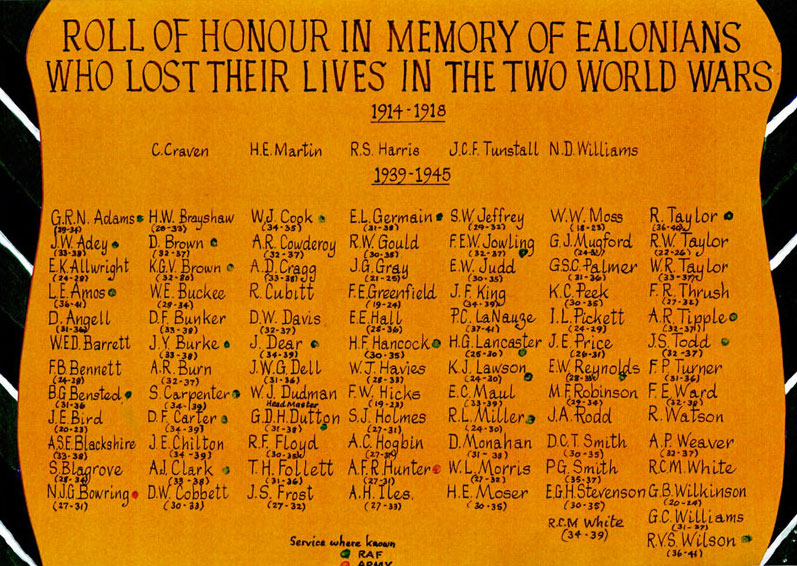
Remembrance Day
On Remembrance Day 2013, Sunday 10 November, we had the opportunity to give thanks
to those boys from the school who 'gave their today for our tomorrows'. Their names appear on
a Plaque of Remembrance in the Ealonian Room.
Illustration: Bert Longhurst
Chairman's Autumn 2013 Report
John C. Oxley, 20 September 2013
2013 has certainly been a busy year with a variety of events taking place
involving the Old Ealonians through the cold Spring and into the long hot and sunny
summer. In March we held the AGM in the Ealonian Room of the Old School building.
Despite the attendance being slightly disappointing, we were able to enjoy an excellent
buffet lunch provided by the College, and a fascinating talk given by Dr Jonathan Oakes,
the Borough of Ealing's archivist, on infamous people associated with Ealing.
During the summer we organised four visits for Old Ealonians to the
London Wetland Centre at Barnes, Windsor Castle, Wimbledon All England Club and Kensington
Palace. Unfortunately, attendance was low for all of these, and in fact the visit to
Windsor Castle was cancelled as I was the only participant! Of the others, I was
only able to visit the London Wetlands Centre due to other commitments but I found it a
fascinating place and I will certainly make a return visit in the future.
On 13 September, after much prodding, the College held a celebration
reception for the centenary of the foundation of Ealing County Grammar School for
Boys. It was a very enjoyable occasion and I was pleased to see so many OEs in
attendance despite the short notice given by the invitations. Inevitably it
was an event full of nostalgia as people reminisced about their School days and in
my case my time as a teacher as well.
I gave a speech about some of the 'happens' and individuals I remember
from my time at the School. It has been suggested that I should write down these
memories so that they can be published in a future edition of the Newsletter. I
had not realised until I came to make notes for my speech that this year marked the
90th anniversary of the formation of the Old Ealonians Association. Is it too
early to begin planning how we will celebrate the centenary in ten years time.
One event remains for this year and that is the Annual Lunch which
will take place on Tuesday 19 November at the College's TASTE Restaurant at the Barons
Court campus. We have already fixed the date for next year's AGM (Wednesday 9
April 2014) which will once again take place in the Ealonian Room (A118) of the old
School Buildings. A booking form for these two events is downloadable from the
Forthcoming Events page of the website We appreciate that the AGM is some
time away so we only require an indication that you hope to attend as this stage, not
a firm commitment. As yet we have not formalised plans for next year's organised
visits etc. but a detailed itinerary will be published in the Spring of 2014.
Now that it is October, Autumn is well advanced and, living in the
Chilterns, it has been a lovely time of year with the yellows and reds of the leaves
on the Beech trees. However, they remind me that Christmas is only two months
away and shops are already full of Christmas goods.
So, may I wish you all the best of health for the remainder of this
year and may we all look forward to a peaceful and stress free 2014.
Celebration of 100 Years of Education in Ealing
John C. Oxley
|
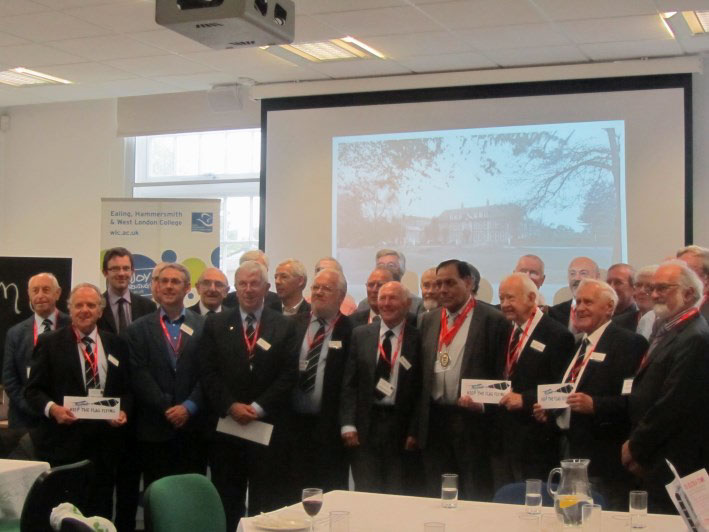
Well it took place! Eventually, after much prompting the Ealing,
Hammersmith and West London College organised a reception to celebrate the centenary
of the foundation of the old School back in September 1913. So on Friday 13
September about fifty Old Ealonians, college staff and guests assembled in the
Ealonian Room (A118) of the Ealing campus of the College at 12 noon. We were
greeted with the offer of a glass of wine before being introduced to the Principal
of the College, Paula Whittle. Despite the short notice provided by the
invitation, nearly thirty Old Ealonians were in attendance. A reporter and a
photographer from the Ealing Gazette were also present and Bert Longhurst, the most
senior OE present, was interviewed and photographed along with other members of the
Association. Photographs for the college website were taken and an article
has subsequently been posted. The old house competition shield had been rescued
from the disastrous fire ten years ago by the caretaker and was included in many of
the photos taken. The shield is now in the safekeeping of Bert Longhurst.
The college had provided a fine buffet lunch which we were invited
to enjoy before the speeches began at 1pm. Firstly, the College Principal,
Paula Whittle, spoke about the College's rich educational heritage from the days
when it was a boys grammar school to now, when it provides a wide variety of academic
and vocational courses. The local MP, Angie Bray, and the Deputy Mayor of the
Borough of Ealing, Councillor Tej Ram Bagha, both highlighted the significance of
the College's activities in the wider community.
|
|
The Chairman of the OEA, John
Oxley, then reminisced about his time at the School and later as a teacher as he
recalled a number of incidents and personnel at the School which brought back fond
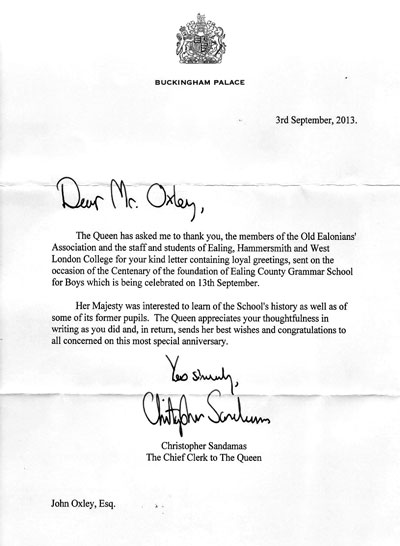
memories to the Old Ealonians present. John concluded by reading the letter
sent to the Queen by the Association and the response which congratulate the
Association and the College on the centenary of the foundation of the School.
|
Edward Hope, another Old Ealonian, then spoke about the career of
perhaps the most famous of ex-pupils of the School, Fred Perry. He recalled
not only his tennis triumphs but also his prowess at tabletennis and how he came
to settle in America. Bert Longhurst had produced a centenary edition of
the Swan Uppers Gazette which saluted the achievements of past pupils of the
School. Copies were distributed to Old Ealonians present who admired the
quality of the pictorial and written work he had produced.
Eventually, all good things must come to an end and after more
than two hours of renewing acquaintances with old school chums it was time to
leave.
|
Profuse thanks were offered to the college for organising the
celebrations, and in particular to the Principal for hosting the occasion and
also to Hannah Burrows from the College who had been the main organiser.
|
In Memory of Peter Middleton
Sadly, news has been received of the death in July
2013 of Peter Middleton, late of King Edward Road Minehead. Peter was a pupil at
EGS from 1937 to 44.
The Association's commiserations are extended to
his family and, in particular, to his daughter, Kate Bromfield, who informed us of
the news. Kate says that he took pleasure in reading the newsletters and kept
in touch with former school friends, including Tony Trott. She has kindly
provided the following tribute to her father's life:
'Peter was born at Ealing, the only child of Frederick
and Violet, known as Vi. His parent had met at work, in the offices of the Great Western
Railway and Vi continued to work there until retirement.
'Peter's father died in 1937, when he was 11 and in
the first year at Ealing County Grammar School for Boys. When war broke out, Peter's
school was evacuated to Aylesbury in Buckinghamshire and shared the local Grammar
School. The boys lived in billets around the town, just going home occasionally at
weekends. Not very wisely, the school returned to Ealing in 1942. Peter entered
the sixth form studying for his Higher Schools Certificate, while Flying Bombs were
dropping. In spite of all this disruption, Peter said he enjoyed school but said he
had to grow up fast.
'At 18, Peter was selected to train for a commission
in the Royal Navy Volunteer Reserve, starting with the University Naval Division at Cardiff
University. There, his love life blossomed, when he met Nadine, a local girl from
Mountain Ash, who was two months older and an undergraduate. However, his training
continued at sea and on shore, until passing out as a sub lieutenant. He served on
minesweepers in the North Sea to the Far East, before ending up with the Commonwealth
Occupation Forces in Japan, at a naval base 10 miles from Hiroshima.
'After demob in 1947, he returned to Cardiff and to
Nadine, bearing a sapphire for an engagement ring. He was so nervous when he proposed,
that he dropped the stone and the romantic moment was ruined by them both crawling around,
trying to find it! They married at 22, Peter as a student completing his degree and
Nadine as the breadwinner, having trained as a teacher. Their daughter, Kate, was born
the week of his finals - and he even managed to knit her a vest! Nineteen months later
came a second daughter, Diane.
'Peter joined Anglo Iranian Oil Company (later BP)
as a graduate trainee and studied for an accountancy qualification. In spite of this, he
hated accountancy and most of his 35 years with the company were spent in broader managerial
roles. He travelled extensively, in Europe and in the Middle East, and he enjoyed his
job until retirement at 58.
'Although Peter's leisure time always included
reading the Guardian from cover to cover, he loved gardening, playing squash and tennis,
and was an avid supporter of Welsh Rugby. Since boyhood, he had a passionate interest
in classical music and jazz and introduced his daughters and grandchildren to his music
tastes from an early age. This was not always appreciated at the time! Kate has
never recovered from the trauma of receiving Kenny Ball's Greatest Hits for Christmas, when
she and her friends were expecting the Beatles! He loved crosswords, completing the
Guardian crossword daily and occasionally phoning his daughters for help with the odd
clue. Love of steam engines and the Great Western Railway was in his blood and he
shared the interest with his son-in-law, Andrew. Peter was always an active member of
the Liberal Party. He took a keen interest in Party developments, not always agreeing
with them.
'Peter and Nadine spent many happy hours walking
and exploring the British countryside - in particular, Suffolk, the Cotswolds, Wales
(naturally!), Cornwall and, of course, Somerset. Much to their daughters' amusement,
they would sometimes collide when walking, because he was looking up at the birds
(feathered variety!), whilst she was looking down at the flowers! They became
particularly attached to the Exmoor area and Minehead was chosen, first for a holiday
home and then as their place of retirement. Over the years, they involved
themselves in a variety of local activities and made many friends. They were
a very close couple, who achieved their diamond wedding anniversary in 2008.
'Amazingly, after Nadine's death later that
year, Peter established a fulfilling, busy life for himself. He taught himself to
cook and often discussed recipes with his daughters. He returned to the church and
was a regular at St Andrews. He took advantage of the many social activities the
area offers, such as the National Trust, the Exmoor Extroverts, the Arts and Film
Societies and the U23A - so much so that family visits had to be booked far ahead!
'Peter was close to his family, despite the
distance. He maintained contact with Nadine's sister, Sonia, and family and spoke
frequently to his daughters and his grand children and enjoyed visits and holidays
with them all.
'Sonia remembers Peter
bouncing into her life nearly 70 years ago, when he first met her sister, Nadine.
Despite the devastating consequences of Nadine's illness and the frustrations of his
increasing frailty, Peter managed to keep his bounce. He is loved and admired for
his warmth, his wit, his energy, his phenomenal memory and the intellectual and emotional
commitment to life, nature, the arts, history and politics, and to good food and wine,
in the company of family and friends. He will always be an inspiration to those who
knew him.'
|
London Wetland Centre Visit on Tuesday 18 June 2013
John C. Oxley
|
On a sultry but bright June day, three Old Ealonians and their wives braved
the M4/A4 traffic to meet at the London Wetland Centre at Barnes. We arrived just in
time for the 11.30am guided tour of the Centre. As our guide explained, the centre is
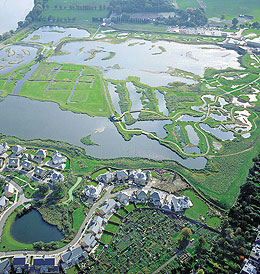
built on the site of the old redundant Thames Water Barn Elms Reservoir site. The
Wetland Centre was the vision of Sir Peter Scott who wanted to establish the first urban
nature reserve. Sadly he died before his dream could be accomplished but work started
in 1995 and was the result of a partnership between the Wildfowl and Wetland Trust (WWT),
Thames Water and Berkeley Homes. The latter helped the project by building luxury
homes in the corner of the site which provided a large portion of the financial cost of
developing the centre. The creation of the various lakes and walkways on the site
was done by using the crushed concrete from the retaining walls of the original
reservoirs. Water taken from the Thames at Hampton in underground tunnels still
supplies the site and its flow is controlled by a series of sluice gates through the
various lakes and lagoons before returning to the river.
|
|
Two routes for visitors have been constructed around half the site and our
guide took us on the West Route through the various world wetlands as she identified the
various ducks and geese from the different wetland habitats which could be seen. We
visited various hides before reaching the 'Wildside' which gave a good view over the various
lagoons, the grassy marsh and the main lake. Here our very informative guide left us
and we slowly made our way back to the main courtyard to the Water Edge Café as it was time
for lunch. After satisfying our hunger we made our way to the Otters Enclosure where we
were in time to watch the three young otters being fed. Their keeper gave an interesting
commentary on their background and feeding habits.
We then separated and four of our party went back to the Theatre in the
main courtyard to watch a short film about the history of the Wetland Centre. Afterwards
my wife Carol and I decided to explore the South Route and made our way through the
sustainable garden and fritillary garden to the Peacock Tower where we had views across
the main lake, the marshland and the lagoons from a different direction. On our way
back we stopped at the sand martin nest bank to see the young chicks being fed in their
nest on CCTV. We also passed the specially designed Berkeley bat house but no bats
could be seen. By now it was time to go home if we were not to get caught in rush
hour traffic. So after the obligatory brief visit to the Centre's shop we set off
for home.
Neither my wife nor I had heard of the Wetland Centre before the trip
was arranged, and it had proved to be a fascinating visit which we had both enjoyed, and
we promised ourselves we would come again to spend more time touring areas of the centre
we had not fully explored on this trip. Despite the weather forecast for the day, it
had not rained and had stayed fine and warm throughout our visit which had proved to be
very worthwhile. The centre is somewhere we would certainly recommend Old Ealonians
to visit in London if they are interested in wildlife and nature.
Old Ealonians and guests on the visit were Brian Edmondson and wife
Jacqui, Alan Rowland and wife Dorothy, John Oxley and wife Carol.
|
Sir David Tanner CBE
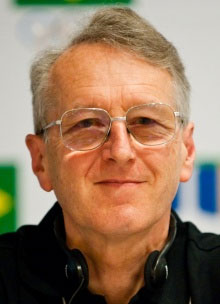
David Tanner, teacher at the school in the late 1970s, has been knighted
for his services to rowing. His investiture took place on 10 April 2013.
The following report is taken from a British Rowing press release:
'As British Rowing’s Performance Director since 1996, David
Tanner has led the sport through its richest ever period of success.
'GB won three medals at the 2000 Olympic Games in Sydney, four
in Athens in 2004 and, at Beijing 2008, topped the rowing medal table with six medals.
'At home for London 2012, Great Britain increased this tally to
nine medals, four of them gold to once again earn the accolade of 'best Olympic nation.
Until London, no rowing nation 'in the modern era' had won more than six medals at an
Olympic Games.
'At the performance helm of the sport, and by astute recruitment
and management of top-level coaching and support staff, his vision and drive have been
behind the creation of a British squad that is consistently capable of winning medals
across all the Olympic and Paralympic disciplines.
|
|
'In 2002 Tanner introduced rowing's 'Start' programme, an
innovative talent identification initiative, which produced five of GB's 10 Olympic
champions in London. Four years later, he launched Great Britain’s Paralympic
rowing programme which produced two golds in Beijing and one in London.
'Tanner first came to the forefront when he coached the
'Ealing Four' in the late 1970s, starting them from scratch as schoolboys from
Ealing Grammar School and taking them through to win three World Championships
medals at Junior and Senior level and an Olympic bronze in Moscow in 1980.
'In the days before Lottery Funding for sport he had a
full-time career in education and was headmaster for 10 years at a large West
London comprehensive. During this time he was Great Britain’s Senior Team
Manager from 1991-1996 which included the Barcelona and Atlanta Olympics.
'After Atlanta, with the prospect of lottery funding
for rowing for the first time he was recruited to the full time role of
Performance Director with British Rowing.
'He is an historian, a Fellow of the Royal Society of
Arts and a Freeman of the City of London. He received an OBE for Services
to Rowing in the 2003 Queen's Birthday Honours, a CBE in the New Year's Honours
of 2009 and a Knighthood for his services to Rowing in 2013.'
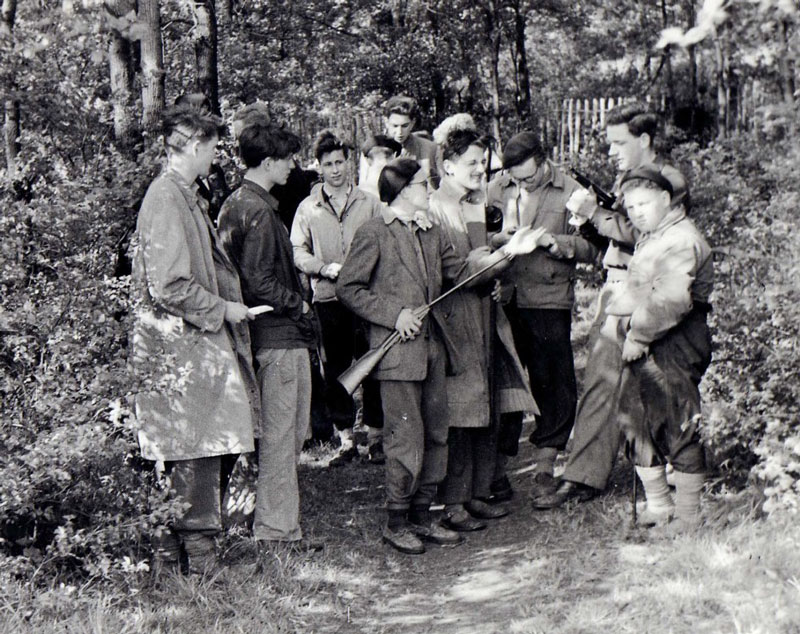
Who is R.G. Mazurkwi?
|
All will be revealed at a later date.
|
Chairman's Spring 2013 Report
John C. Oxley, 20 February 2013
Since the last Newsletter, the Annual Lunch has taken place at
the TASTE Restaurant of the Ealing, Hammersmith and West London College at the
Hammersmith Campus. It was a very enjoyable experience with good food and
excellent company. So much was the lunch enjoyed that we are planning to
repeat it again this year.
A report appears elsewhere. The Newsletter Editor, George
Barker, has still not fully recovered from his serious illness last summer so John
Holdstock has taken over the task of producing future editions of the Newsletter.
Our Secretary, Donald Robertson, was also very seriously ill at the beginning of the
year but thankfully he is now on the road to recovery.
On a much more pleasant note, on behalf of the Association, I would like
to offer many congratulations to David Tanner CBE on being awarded a knighthood in the
New Year's Honours List for his services as performance director for GB Rowing for more
than 16 years. He is the person mainly responsible for putting in place the
facilities and people necessary to ensure the great rowing successes in recent years in
this country.
David was a teacher at Ealing Grammar School in the late 1970s where he
formed the 'Ealing Four' rowing team which went on to win three World Championship medals
and an Olympic Bronze at Moscow in 1980.
As you will see below, your committee has planned a series of visits for
this year for OEA members in which I hope many of you will be able to participate.
Under our new Rules of the Association, the Annual General Meeting has
to be held in March or April each year and I am pleased to state that we have been able
to book the Ealonian Room (A118) in the Old School on Friday 22nd March 2013.
The AGM will take place at 12.30pm and will be followed by a buffet
lunch provided by the College. Then I am pleased to announce that Dr Jonathan
Oakes, the Chief Archivist of LB of Ealing Libraries has agreed to give an illustrated
talk on infamous people associated with Ealing.
I am also pleased to inform the members that Mr Donald Kincaid, the
last Headmaster of Ealing Green High School has agreed to allow his name to go forward
for re-election as President of the Association.
The College is planning an event in September to mark the centenary
of the admission of the first pupils to the School in 1913. As yet we have no details
but will circulate information as soon as it is known. We are still looking for
material regarding the history of the School and if anyone has anything that might be
interesting for inclusion in a commemorate book then will you please let either Donald
Robertson or me know.
The Committee felt that in future, editions of the Newsletter should
include stories about some of the activities of pupils whilst at the School.
Some of us well remember the snowball fights with the pupils of Clarks College or
playing football in Walpole Park with our blazers as goalposts but still wearing our
caps! If you have any stories or reminisces amusing or otherwise you are happy
to share, then please send them to our Newsletter Editor, John Holdstock.
Belatedly may I wish you all a happy and healthy New Year and look
forward hopefully to seeing many of you again at the AGM?
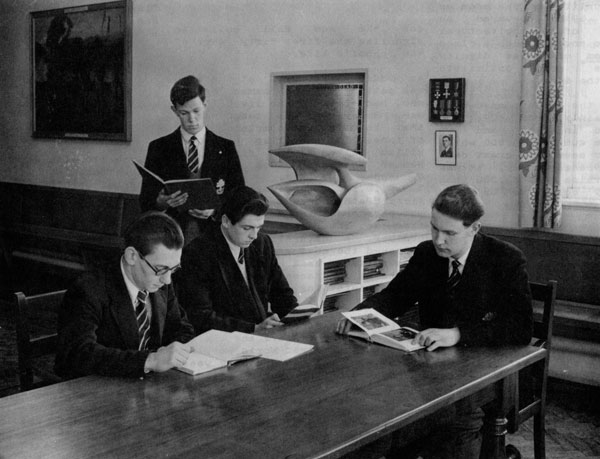
The Ealonian Room
John Holdstock
|
This photo was recently sent to John Holdstock by a
contemporary from his year group, 1952 to 1959.
He believes that he recognises Dave Gardner, seated front
right, and Cocker (first name not known), standing. He does not know
the names of the other two who are seated. Can you help?
The abstract sculpture in wood was called ‘Flight’.
Do you know created it?
The room, and presumably the sculpture, was destroyed in
a fire. The room was rebuilt not long ago.
|
|
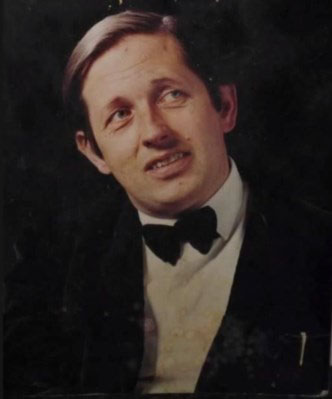
In Memory of John Railton,
1934 - 2013
Old Ealonians who attended the school in
the 1950's and 1960's will be saddened to hear of the death on 19 February
2013 of John Railton, who taught music.
|
He was a very popular, dynamic and
enthusiastic teacher, and was particularly remarkable for having only one
arm following an operation for cancer.
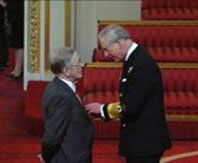
Just over a year ago, when he was living in
Totnes, John was awarded an MBE for services to music.
He was acknowledged as an acclaimed musician
and composer and had retired in 2009 as a musical director and conductor of
Dartington Community Choir.
Ealing Youth Opera reported John's death
as follows:
'We are very sad to report that our
founder John Railton passed away on Tuesday 19th February.
'John started EYO in 1959 when he
was a teacher at Ealing Grammar School, and remained conductor and musical
director for the next twenty years. We all have a great deal to be
grateful to him for and send our appreciation and heartfelt condolences to
his family.'
A colleague from that period was John
Harman, who writes:
'It was a privilege to work with John
as a colleague. He had the rare quality of being unassuming and inspiring
at the same time. My wife, Margaret, worked alongside his wife, Kathleen
at Costons school.
'My most abiding memory of John was his
courage and virtuosity in playing the organ at Assembly within only a few
weeks of losing his arm.
'But I remember also the Carmina Burana
production in Westminster. Maurice Hill and Geoff Clear had provided
staff with translations of the Latin and German lyrics.
|
|
'We hoped that our
young charges were not entirely aware of quite what medieval bawdy they were
singing!'
Peter Hillman (1957-1962) writes the following appreciation:
'John Railton came to Ealing Grammar School as its music
master in January 1958, if my memory serves me correctly, when I was in form 1A. It
immediately became apparent that his enthusiasm was infectious and it wasn't long before he was
putting together a large choir to perform Handel's Messiah. He insisted that all the boys in
the first and second forms should sing the treble part unless they really were tone deaf, and he
used to attract any not watching him conduct by waving his pocket handkerchief vigorously above
his head. The lower voice parts were enhanced by some members of staff and I can still
picture Mr Shearn, an English master, giving his all in the choruses on the other side of the
church chancel when we came to the performance.
'He was nothing if not ambitious and as recalled by
John Harman we mounted Orff's Carmina Burana in Central Hall Westminster with a professional
baritone soloist, a New Zealander called John Hauxvell. An LP record was made of the
performance which was in about 1960, by which time my voice was breaking and I was trying to sing
solo, something I did not enjoy, but John encouraged me and forbade me to leave the choir.
I still have the LP, and not having anything to play it on I had it transferred recently on to a
CD.
'John Harman mentioned John's illness and the amputation
of an arm - his subsequent playing the organ in assembly was wonderful to behold. Somewhere
down the line he acquired the nickname 'Sid' as a result of a parody in the sixth form's rather
scurrilous magazine called 'The Nut' where he was portrayed as a pop star with a group, Sid
Railton and The Rockets, and the name stuck.
'Wonderfully professional and moving services of nine
lessons and carols were undertaken at St Mary's Church every Christmas.
'Following the success of Carmina Burana John was
inspired to put on other works which one would not normally expect a school to produce -
Walton's Belshazzar's Feast and, just before I left in 1964, Beethoven's Choral Symphony.
'John instilled in me a love of choral singing which
I have enjoyed all my life and continue to do so, currently with West Sussex Philharmonic
Choir, and I shall be always thankful that he made me persevere through the alto line until
my voice broke properly and I, and I suspect many others, will remember him with great
affection.
You can also see a delightful tribute to John made
following his investiture last year, by going to the following link on You Tube:
http://www.youtube.com/watch?v=q1-h16Kya8U.
Numerous other items about John can be found by typing 'John Railton MBE' into
Google.
|
|